

Milkweed Meadow: Needle Felting & Embroidery 2-Day Workshop
March 15 @ 10:00 am – March 22 @ 4:00 pm
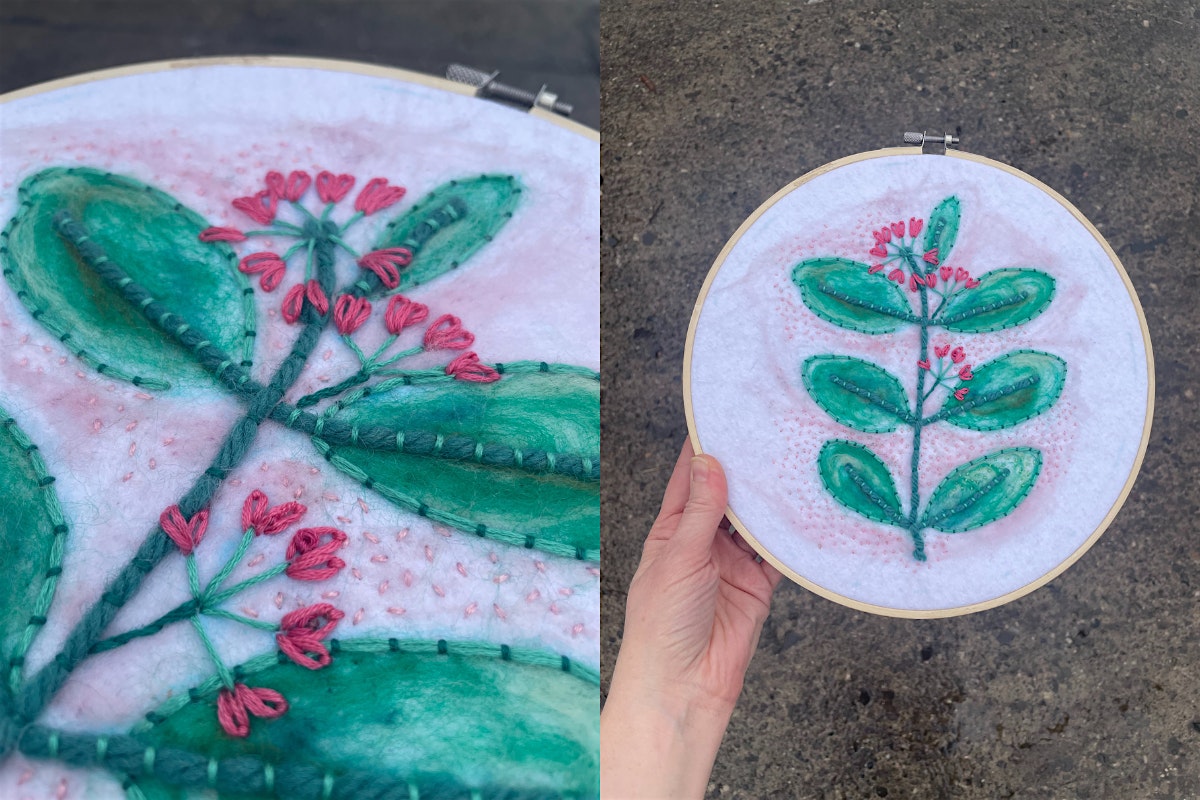
Discover the beauty and ecological importance of milkweed through fiber art at the Toronto Botanical Gardens! In this immersive two-day workshop, you’ll create a textile artwork inspired by actual milkweed herbarium specimens—plants that are essential to monarch butterflies and countless other pollinators.
Working with a soft palette of greens, browns, warm pinks, and purples on creamy white felt, you’ll learn two complementary textile techniques: needle felting (which allows you to “paint” with wool) and hand embroidery (which adds intricate detail and texture). No prior drawing or embroidery experience is necessary.
Milkweed is one of nature’s most remarkable plants, playing a critical role in supporting biodiversity and sustaining fragile ecosystems. For monarch butterflies, milkweed is literally a matter of survival—it is the only plant on which they can lay their eggs, and milkweed leaves are the sole food source for their caterpillars. The plant’s leaves also provide monarchs with chemical defenses against predators, while its nectar-rich flowers fuel the adults’ incredible multi-generational migrations across thousands of miles.
Beyond monarchs, milkweed is a keystone species that supports an entire web of life. Its flowers provide essential nectar for bees, wasps, flies, and hummingbirds, while its distinctive seed pods offer nourishment for birds.
By creating art inspired by milkweed, we celebrate this extraordinary plant and reflect on ecosystems and interconnection.
Day One: Needle Felting Foundations
- Introduction to milkweed ecology and examination of herbarium specimens
- Observational drawing: tracing and adapting milkweed forms to create your unique composition
- Transferring your drawing onto felt backing
- Needle felting techniques: learning to “paint” with wool roving
- Building up layers of color and creating shading effects
- Developing leaves, stems, seed pods, and flowers using our nature-inspired color palette
Day Two: Embroidery Details
- Review of Day One work and troubleshooting
- Introduction to hand embroidery stitches for adding definition and detail
- Stitching techniques for different elements: veining in leaves, texture in seed pods, delicate flower details
- Combining needle felting and embroidery for dimensional effects
- Finishing techniques and backing options
- Care instructions and ideas for continuing your practice at home
What You’ll Learn
- How to translate natural forms into fiber art through observational drawing and tracing
- Needle felting fundamentals: choosing needles, controlling wool placement, creating gradients and shading
- Essential embroidery stitches for botanical details
- Color theory and blending techniques specific to wool
- How to combine two textile techniques for rich, layered results
- Strategies for creating depth, dimension, and naturalistic effects
All materials are provided, and you’ll take home supplies to continue your creative practice. Optional items to bring:
- Comfortable clothing (small wool fibers may cling to fabric)
- An apron or smock if desired
- A camera or phone to photograph the herbarium specimens (optional—printed reference images will be provided)
Schedule: Sunday, March 15 and 22 from 10 a.m. to 4 p.m. There will be a one-hour break for lunch. We recommend bringing a lunch as there are limited options nearby.
Registration: Public $145, Members $125 (plus applicable taxes and fees)
About Amanda McCavour
Amanda McCavour is a Canadian artist who works with stitch to create large-scale embroidered installations.
Her immersive installations speak to themes of memory, environment, colour and line. She is interested in finding connections between scientific research and decorative patterns found in textiles and wallpaper. Her lace-like pieces are made by sewing into fabric that dissolves in water. When the fabric is dissolved, the thread drawings interlock together even without a base. Plants and their ecologies are similarly linked—a biological network is a bound system that sustains a community of plants.
McCavour holds a BFA from York University and an MFA in Fibers and Material Studies from Tyler School of Art in Philadelphia. McCavour shows her work in galleries nationally and internationally and has completed residencies at Harbourfront Centre’s Textile Studio in Toronto, and the Klondike Institute of Art and Culture in Dawson City, Yukon. She has been recognized by the Ontario Crafts Council, The Canada Council for the Arts, The Handweavers and Spinners Guild of America, The Ontario Society of Artists, The Surface Design Association, and The Embroiderers Guild of America.
Join Toronto Botanical Garden
Join the Toronto Botanical Garden (TBG) as a member to get a discount on this program, upcoming events and classes, and free parking. A TBG membership helps you deepen your knowledge and connection to the natural world, become a part of a dynamic community of plant people, and be inspired! Become a member!
Additional Program Information
- Please review our Refund Policy and Terms of Agreement.
- For more information on accessibility at the garden please review our Accessibility Features webpage. If you have any accessibility requirements during your program please email [email protected].
- To learn more about the Toronto Botanical Garden and our programs, please review our list of Frequently Asked Questions.
Details
Related Events

March 15 @ 10:00 am – March 22 @ 4:00 pm