By Veronica Sliva
When I was a kid everyone in the neighbourhood had a big patch of rhubarb (Rheum rhabarbarum) growing in the back corner of their yard. My mother deemed the plant not pretty enough for her flower borders. Hence, with its large, heart-shaped leaves and distinctive red stems, it was tucked out of the way and forgotten for most of the year.
Come early spring, however, when the plant’s stems were 25 to 30 centimetres (10 to 12 in) tall, my Mom always sent me down to the garden to “pull” some rhubarb. That meant a dessert of sweetened stewed rhubarb with custard would soon be on the table. A week later, there might be rhubarb crisp and by mid June when it was strawberry time, rhubarb/strawberry pies were guaranteed.
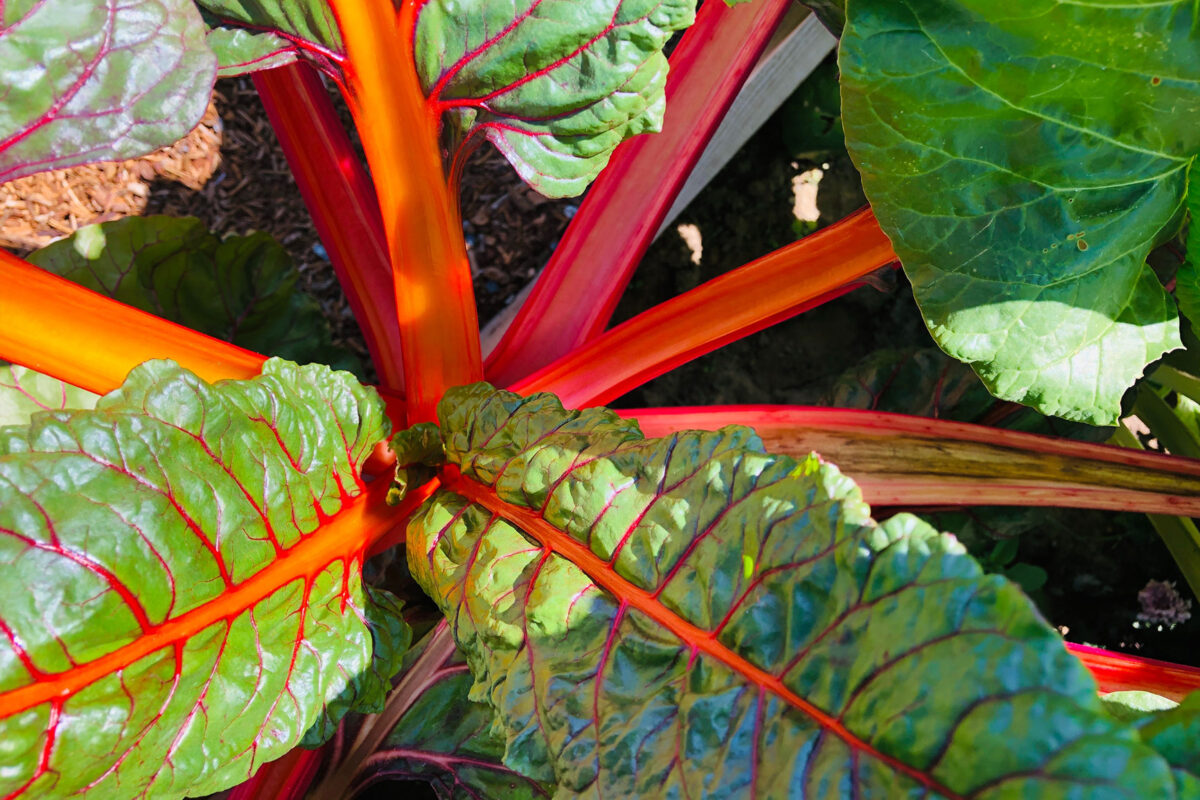
My mother didn’t think rhubarb belonged in her flower garden, but like fashion design, times change and with its ruby stems and umbrella-like leaves, rhubarb can make a real statement in the garden, bringing height and structure as well as a splash of colour that returns year after year—and you get dessert, too!
Where does rhubarb come from?
Botanically, rhubarb is not a fruit, but a hardy perennial in the buckwheat family (Polygonaceae), native to southern Siberia. It got its name from the Russians who grew it along the Rha River (now the Volga). In ancient China it was used as a medicinal herb and for centuries was traded alongside tea as a cure for stomach aches and fevers.
In the 17th century the English were the first to eat rhubarb, but they started with the leaves, which look a little like chard—not a good idea. Rhubarb leaves contain a toxic amount of oxalic acid and are poisonous, causing cramps, nausea and sometimes death. By the late 18th century Europeans discovered that the tart stalks were quite edible when sweetened with sugar and perfect for pies. Hence rhubarb was nicknamed “Pie Plant.” Early settlers brought rhubarb to North America.
Rhubarb varieties
• ‘Canada Red’ produces shorter, more slender stalks than other varieties but is tender and very sweet with good red colour. It tends to produce only a few seed heads.
• ‘Cherry Red’ (also known as ‘Cherry’ or ‘Early Cherry’) has long, thick stalks that are a rich red inside and out.
• ‘Crimson Red’ (also called ‘Crimson’, ‘Crimson Cherry’ or ‘Crimson Wine’) produces tall, plump, brightly coloured red stalks.
• ‘MacDonald’ has tender skin on the brilliant red stalks.
• ‘Valentine’ has broad, deep red stalks with a good rosy colour when cooked. It produces few or no seed heads.
• ‘Victoria’ is a speckled type that produces medium-sized stalks of excellent quality and good flavour. The light green stalks develop pink speckling, especially at the bottom of the stalk.
How to plant rhubarb
Though you can grow rhubarb from seed, most gardeners either get a division from another gardener or purchase rhubarb ‘crowns’ from a garden centre or online. Plant in the fall or spring when crowns are still dormant or just leafing out. Choose a site with rich, fertile soil and good drainage.
Space crowns so the eyes are about 7 cm (3 in) below the soil surface with buds facing upward, about 60 to 120 cm (2 to 4 ft) apart and 90 to 120 cm (3 to 4 ft) between rows. Water well at the time of planting.
Rhubarb should not be harvested the first year so as to allow the plant to focus on root development.
The best growing conditions for rhubarb:
• Grows best in full sun, but will tolerate partial shade.
• Rhubarb is a heavy feeder benefiting from lots of compost and organic matter.
• Does best where the average temperature falls below 4°C (40ºF) in the winter and below 24°C (75ºF) in the summer.
• Water regularly, keeping the soil moist, but not wet.
• Mulch generously (straw is a good mulch) to retain moisture and discourage weeds.
How to maintain rhubarb plants
In spring, apply fertilizer (10-10-10) when the ground is thawing. Rhubarb needs sufficient moisture,
especially during the hot, dry days of summer. Water well and consistently.
Remove seed stalks as soon as they appear so the plant’s energy goes to root development. Divide rhubarb roots every three to four years when plants are dormant in early spring. Be sure each division has at least one healthy bud.
Dealing with pests and diseases
Pests and diseases are rarely an issue with rhubarb, but they may be affected by crown rot and a beetle called Rhubarb curculio (Rhubarb weevil).
How to harvest rhubarb
Choose firm stalks 20 to 38 cm (8 to 15 in) long. To harvest, grab the base of the stalk and pull it away from the plant with a twist. If this doesn’t work, you can cut the stalk at the base with a sharp knife. Cut off the leaf and dispose. With young plants, harvest only in the spring allowing the plant to grow on to regenerate for next year’s growth. Avoid harvesting more than a third of the leaves in a year to keep the plant going strong.
Storing rhubarb
Store unwashed and trimmed stalks in a mesh bag or loose plastic in the refrigerator for up to two weeks. Wash only before using it. To freeze wash and cut the rhubarb stalks into 2.5 cm (1-in) chunks and seal in an airtight bag.
Photos from Unsplash